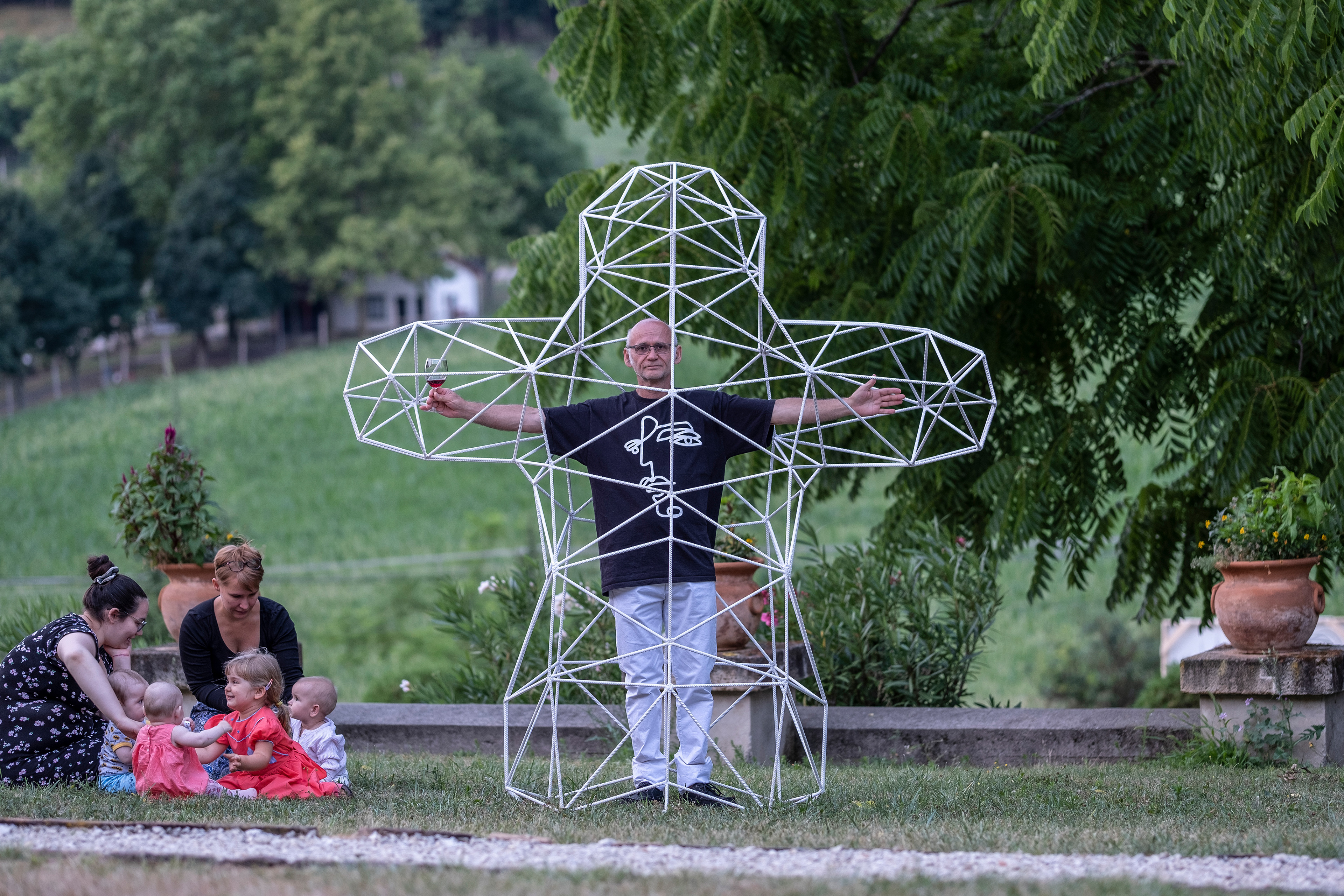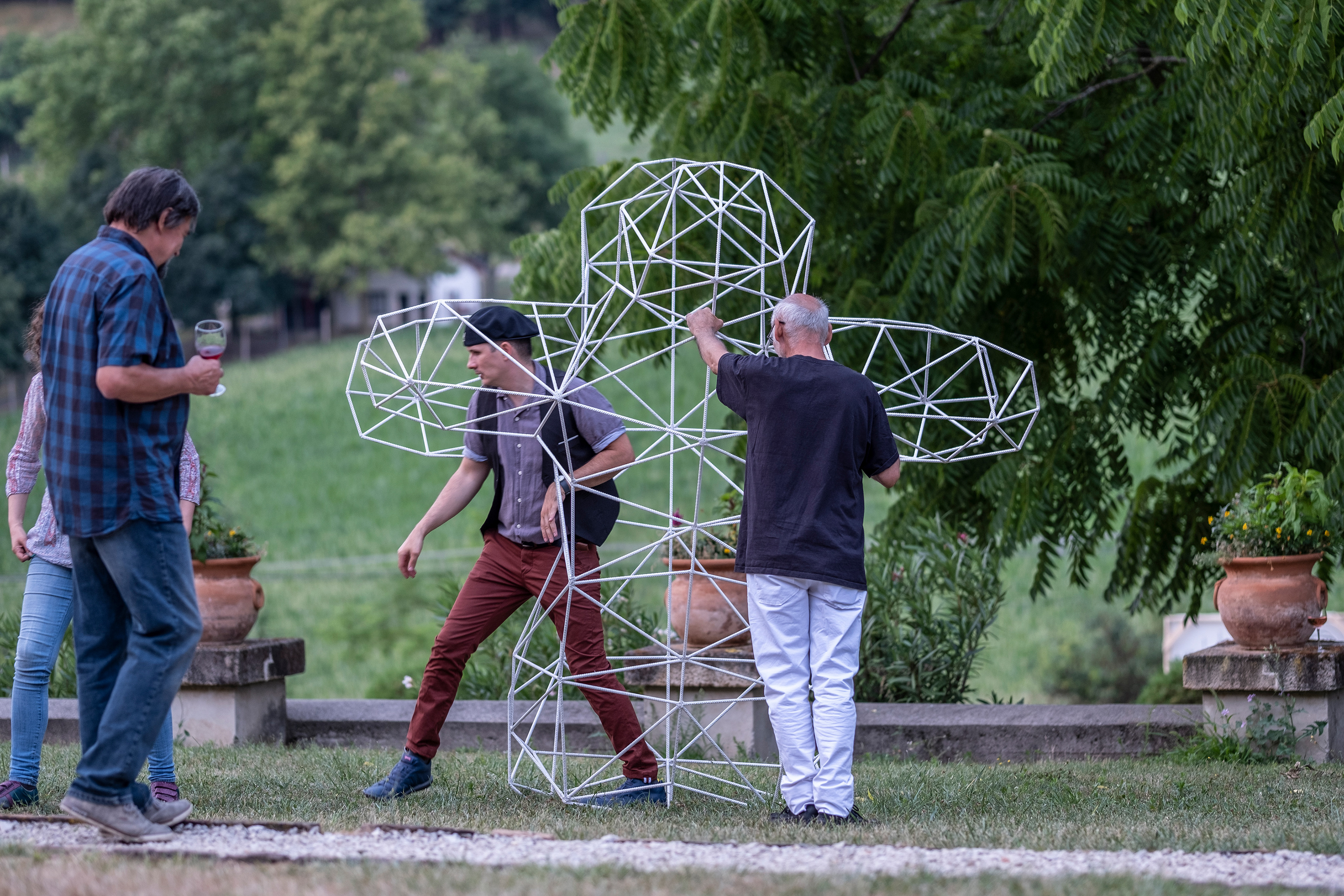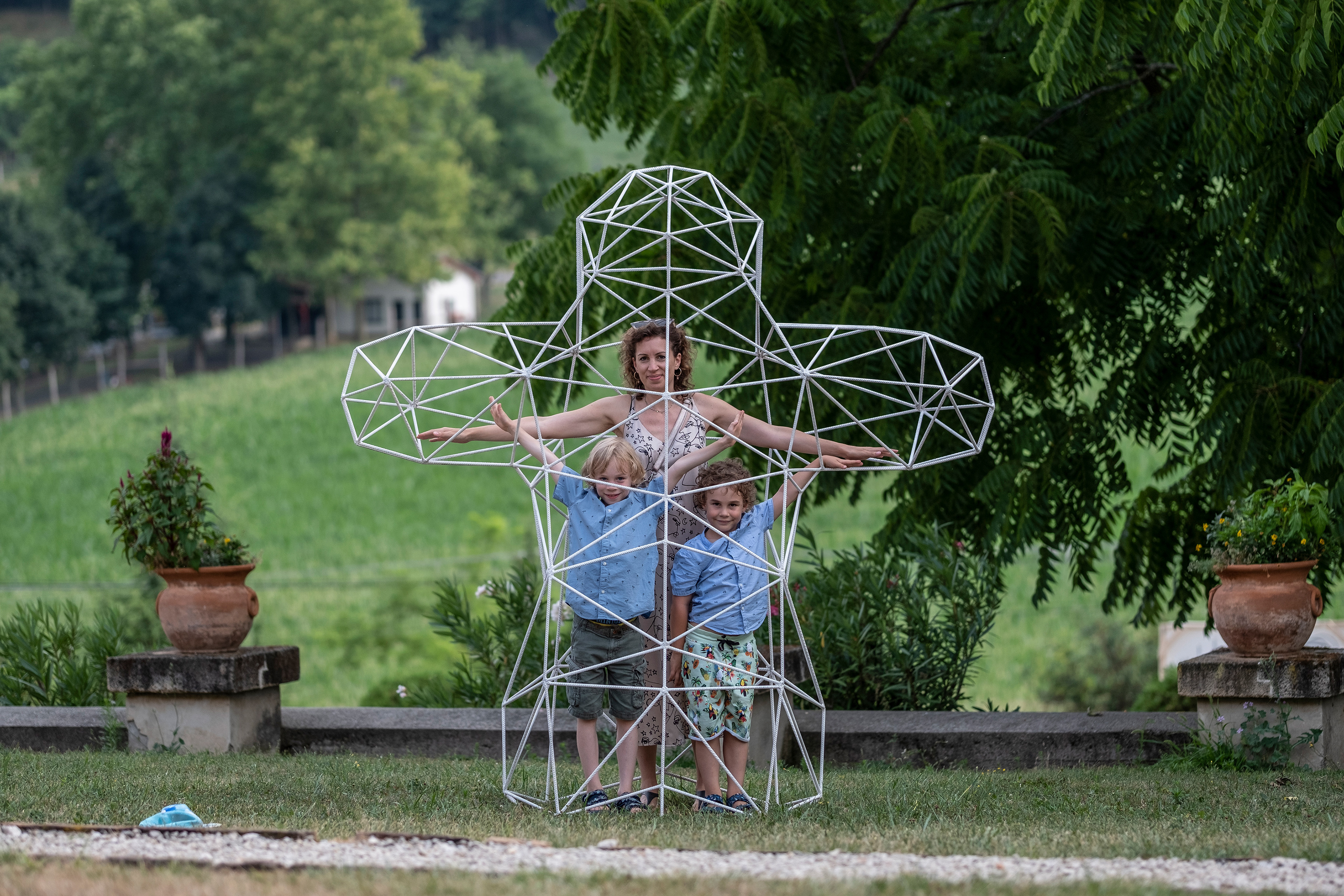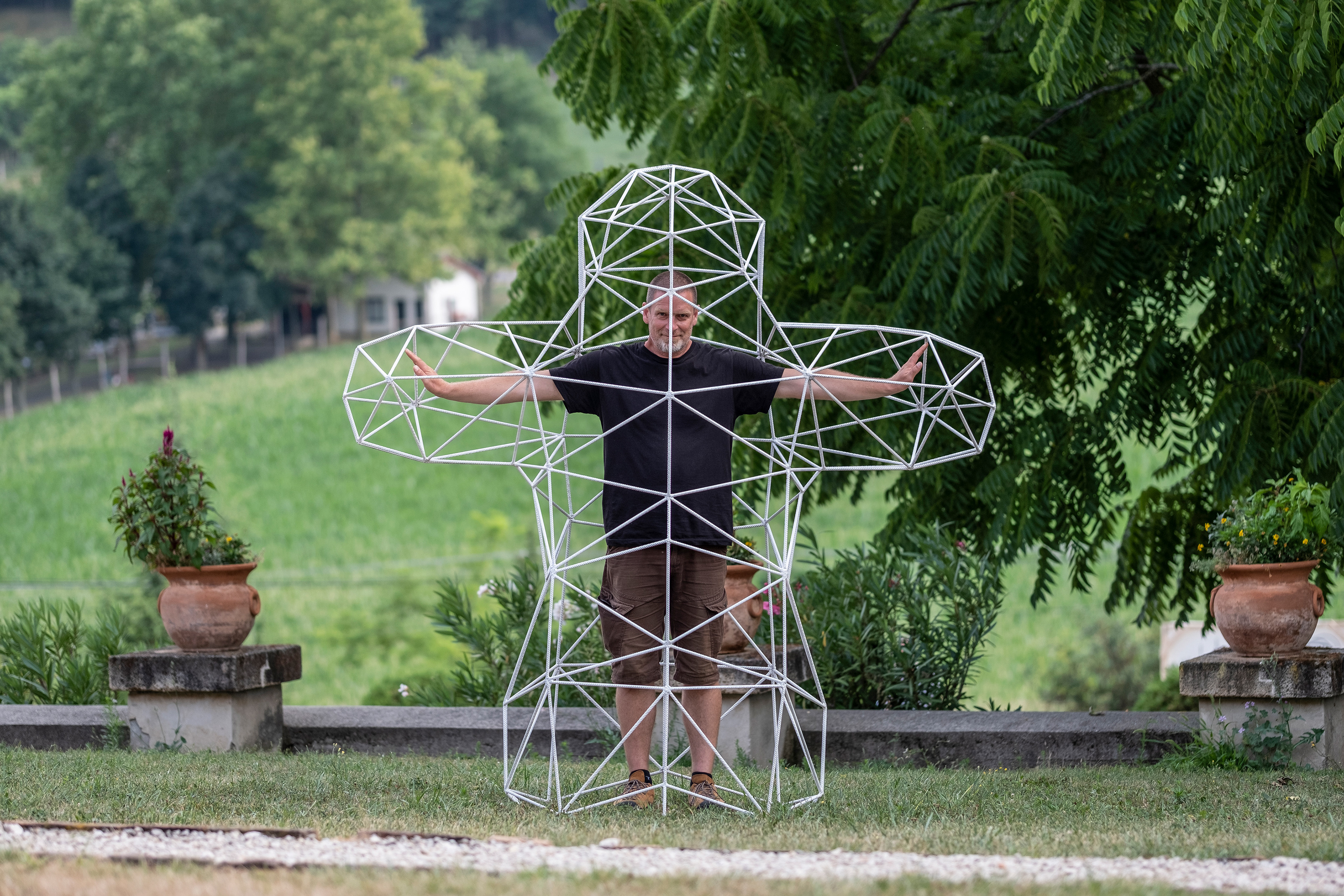
Tool for Privacy Practices (1.0) - Vitruvian Position - installation
Miszla Art Residency, Miszla, Hungary, 2021
Miszla Art Residency, Miszla, Hungary, 2021
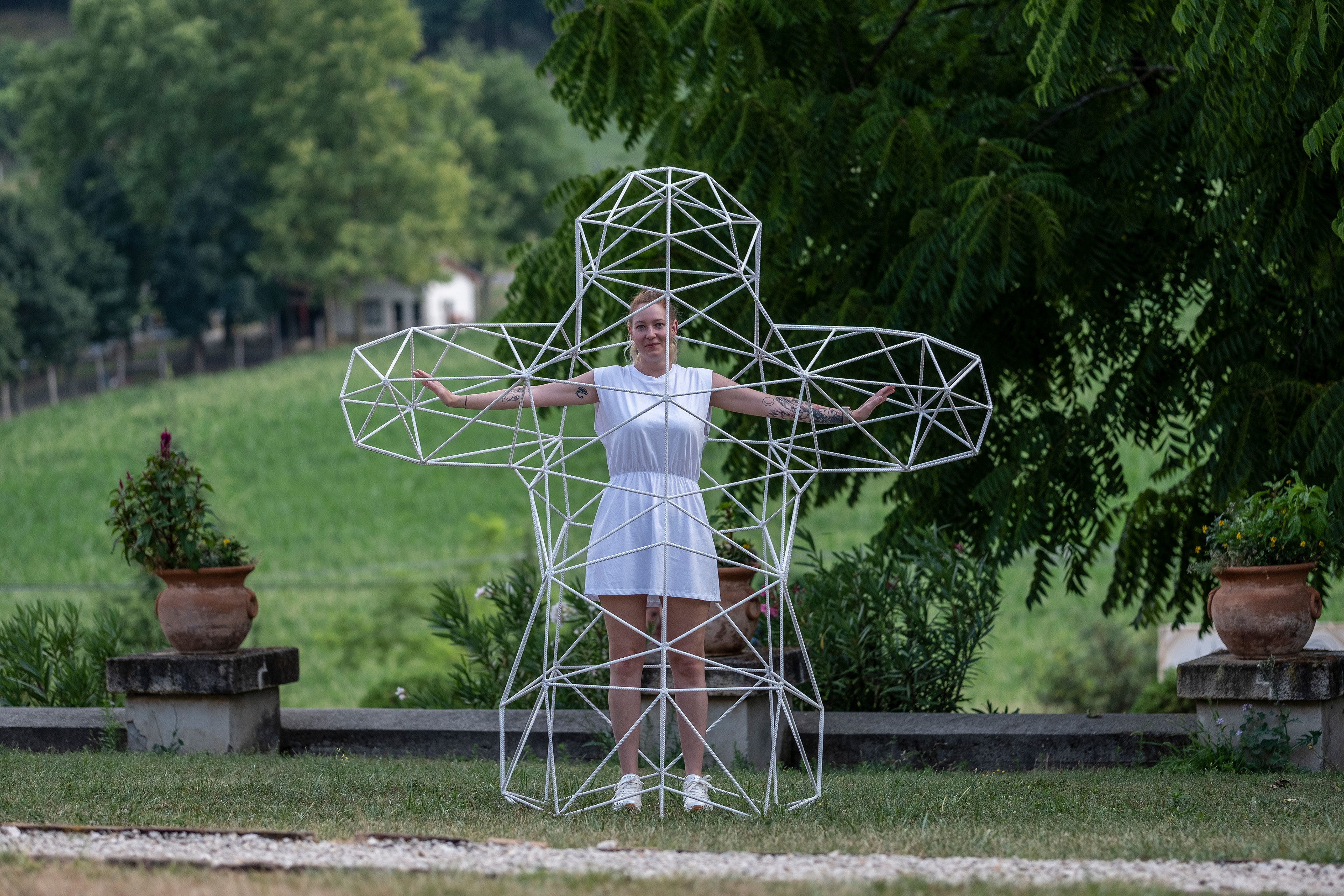
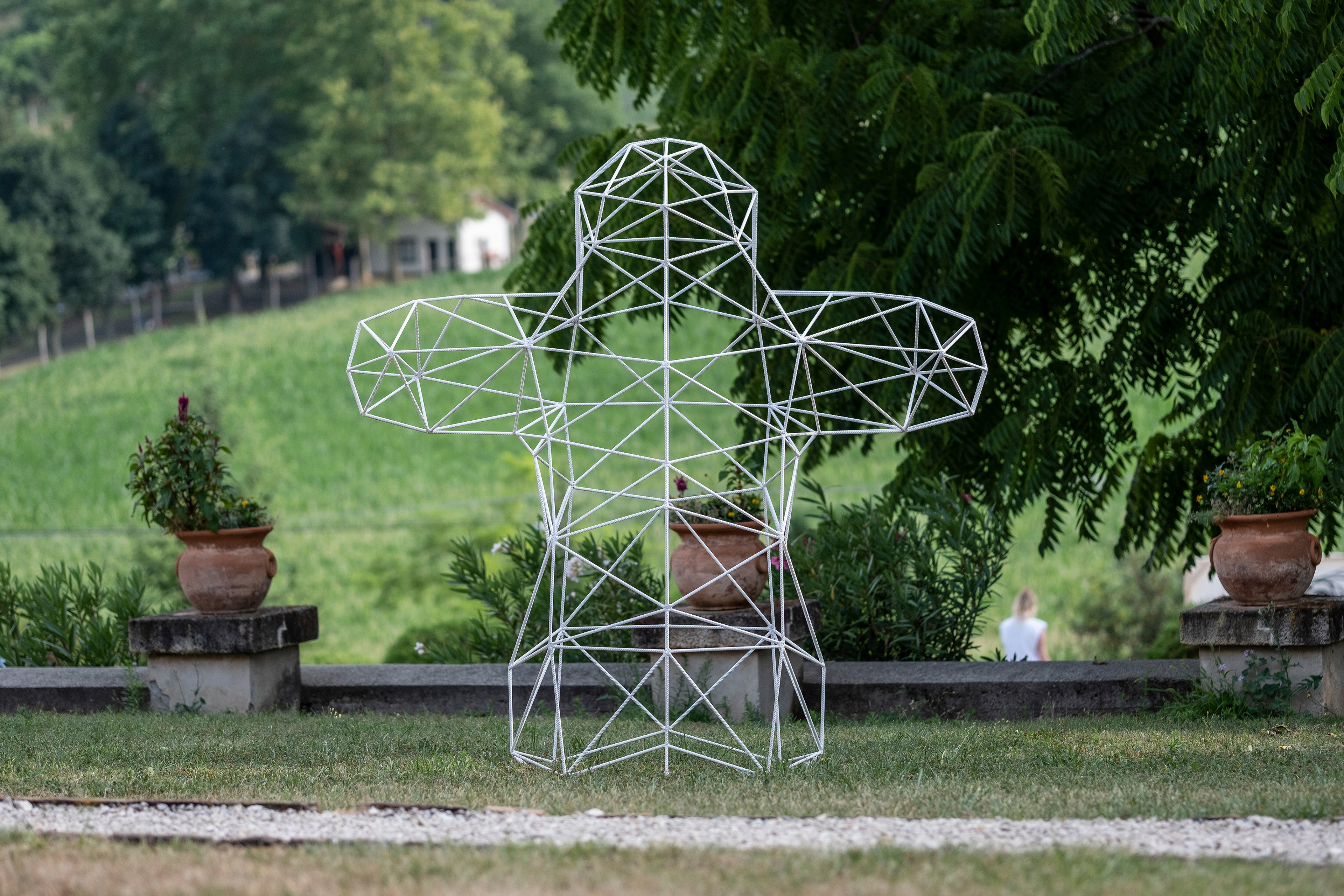
Tool for Privacy Practices (1.0) – Vitruvian Position is a body-scale, spatial aid that transforms the demarcation of private sphere from a theoretical concept into a tangible physical experience. Its central element is a mesh-like, geometric frame that outlines the imaginary extended boundaries of the human body. Evoking the iconic pose of the Vitruvian Man, the structure functions simultaneously as a protective net and a cage: it defines, isolates, and restricts.
While Leonardo da Vinci’s Vitruvian Man—drawing on the writings of Marcus Vitruvius Pollio—presented the proportions of the human body to Renaissance Humanism as proof of the rational order of the universe, here this ideal shifts. The figure of the human inscribed in a circle and a square does not carry the promise of cosmic harmony, but rather the necessity of drawing boundaries. In this context, the gesture of outstretched arms is a defensive reflex: a "thus far and no further" directed toward the outside world. The space designated by the structure is not an abstract ideal, but an individual and temporary territory that acts as a kind of analog "firewall," attempting to protect internal integrity.
The work makes an ironic proposition for something we are increasingly incapable of in the digital age: the physical delineation of private sphere. It confronts us with the Enlightenment’s image of humanity—the ideal that made the individual the measure of themselves. Today, this self-determining subject has entered a state of permanent accessibility and constant interruption. While two decades ago mobile technology was a coveted tool for social connection, today it stretches around us as an invisible web of algorithmic control and the data economy. "Smart" devices have dismantled the walls of the private sphere—partly voluntarily, partly by necessity—while we search ever more desperately for the possibility of retreat.
Created during the COVID-19 pandemic, the work gained particularly acute relevance when physical distancing and isolation became everyday experiences. The white wireframes are transparent, yet they constitute a boundary: they refer simultaneously to the spatial rules established during the pandemic and to the new meaning of personal space. An arm’s length was no longer an aesthetic canon, but a physical unit of measure for responsibility and survival. What was previously an abstract question suddenly became a concrete, bodily experience: the individual retreats within boundaries that are partly imposed and partly self-chosen.
The object also evokes the ritual territorial claims of childhood games—the "sacred" circles scratched into the dirt. Vitruvian Position serves as a reminder that preserving individuality in the contemporary world is not a given, but an active, conscious practice. In this sense, the private sphere is not a self-evident state, but a fragile boundary to be marked out again and again—a temporary space that we must define even within our most personal human relationships.
Segédeszköz Privátszféra Gyakorlatokhoz - Vitruviusi alapállás (1.0) - installáció
Miszla Art Művésztelep, Miszla, Magyarország, 2021
Miszla Art Művésztelep, Miszla, Magyarország, 2021
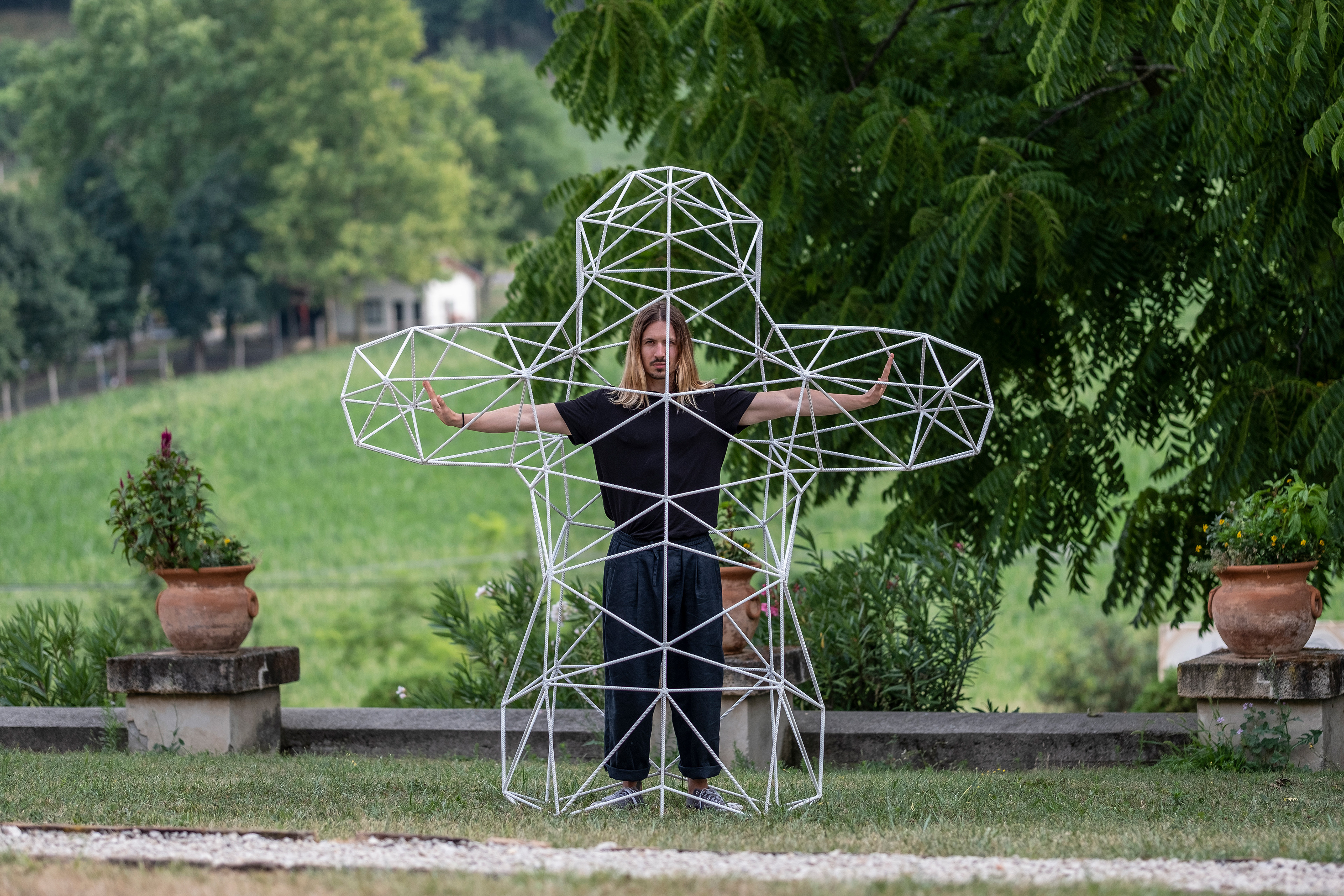
A Segédeszköz Privátszféra Gyakorlatokhoz - Vitruviusi alapállás (1.0) egy testléptékű, térbeli segédeszköz, amely a privát szféra kijelölését nemcsak elméleti kérdésként, hanem fizikai tapasztalatként teszi megélhetővé. Központi eleme egy hálós szerkezetű, geometrikus váz, amely kirajzolja az emberi test kiterjesztett, képzeletbeli határait. A vitruviusi ember ikonikus alapállását idézve a szerkezet egyszerre működik védőhálóként és kalitkaként: kijelöl, elkülönít és korlátoz.
Míg Leonardo da Vinci Vitruvius-tanulmánya – Marcus Vitruvius Pollio írásaira támaszkodva – a reneszánsz humanizmus számára az emberi test arányait az univerzum racionális rendjének bizonyítékaként jelenítette meg, addig itt ez az ideál eltolódik. A körbe és négyzetbe illesztett ember alakja nem a kozmikus harmónia ígéretét hordozza, hanem a határkijelölés kényszerét. A kitárt karok gesztusa ebben a kontextusban védekező reflex: egy „eddig és ne tovább” a külvilág felé. A szerkezet által kijelölt tér nem absztrakt eszmény, hanem egyéni és ideiglenes territórium, amely egyfajta analóg „tűzfalként” kísérli meg védeni a belső integritást.
A munka ironikusan tesz ajánlatot arra, amire a digitális korban egyre kevésbé vagyunk képesek: a privát szféra fizikai kijelölésére. A felvilágosodás emberképével szembesít – azzal az ideállal, amely az individuumot saját maga mértékévé tette. Ez az önrendelkező alany mára a permanens elérhetőség és az állandó megszakítottság állapotába került. Míg két évtizede a mobiltechnológia a társadalmi kapcsolódás vágyott eszköze volt, mára az algoritmikus kontroll és az adatgazdaság láthatatlan hálójaként feszül körénk. Az „okos” eszközök lebontották a magánszféra falait – részben önként, részben kényszerből –, miközben egyre kétségbeesettebben keressük a visszavonulás lehetőségét.
A mű a Covid–19 világjárvány idején készült, és különösen aktuális jelentést kapott, amikor a fizikai távolságtartás és az elkülönülés mindennapi tapasztalattá vált. A fehér drótvázak átláthatóak, mégis határt jelentenek: egyszerre utalnak a járvány idején kialakult térhasználati szabályokra és a személyes tér új jelentésére. A karnyújtásnyi távolság ekkor már nem esztétikai kánon, hanem a felelősség és a túlélés fizikai mértékegysége lett. Ami korábban elvont kérdés volt, hirtelen konkrét, testi tapasztalattá vált: az egyén részben rákényszerített, részben önként vállalt határok közé húzódik vissza.
Az objekt felidézi a gyermekkori játékok rituális területfoglalásait is, a földbe karcolt, “szent” köröket. A Vitruvian Position arra emlékeztet, hogy az individualitás megőrzése nem adottság, hanem aktív, tudatos gyakorlat. A privát szféra ebben az értelemben nem magától értetődő állapot, hanem újra és újra kijelölendő, törékeny határ – egy ideiglenes tér, amelyet már a legszemélyesebb emberi kapcsolatainkban is definiálnunk kell.