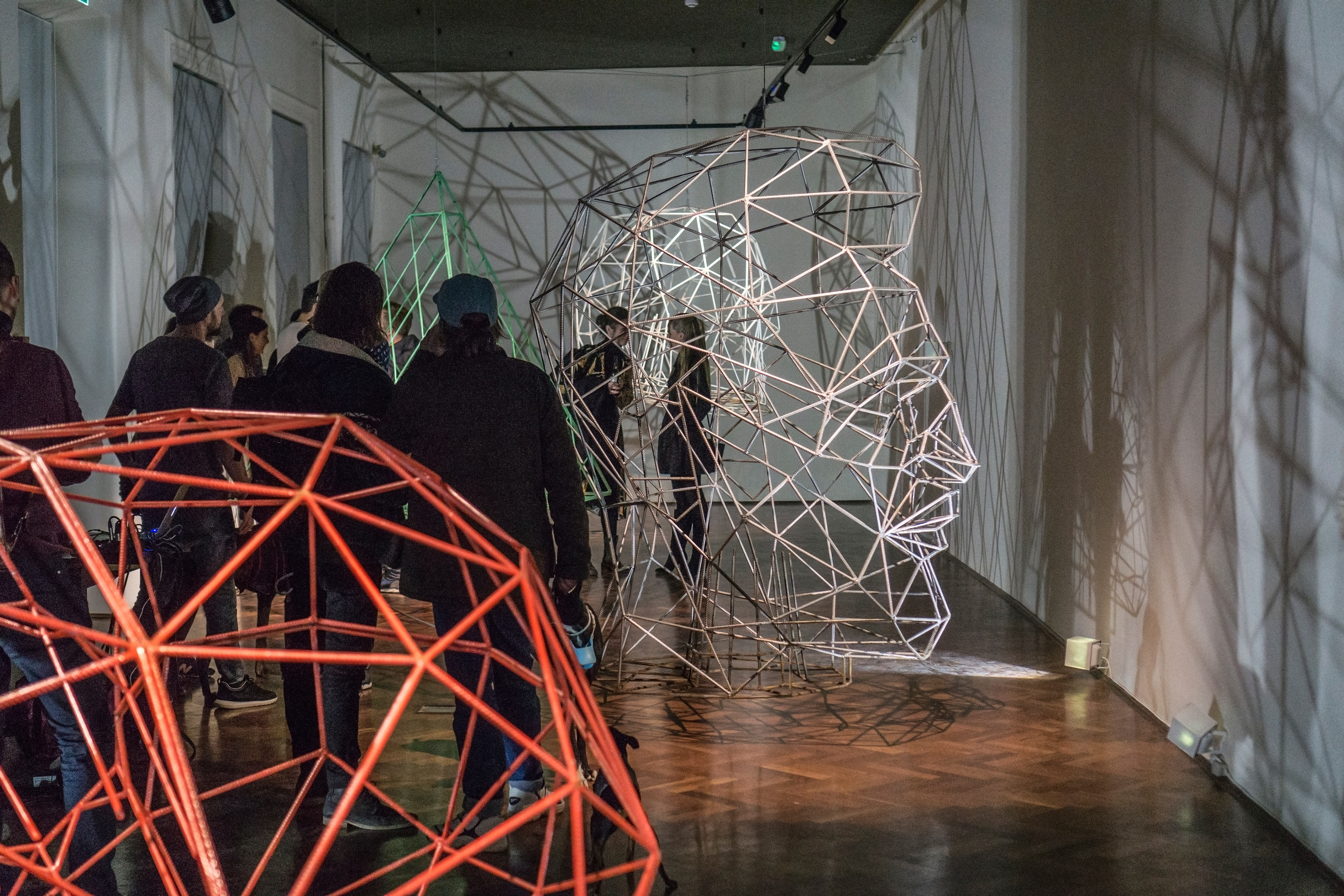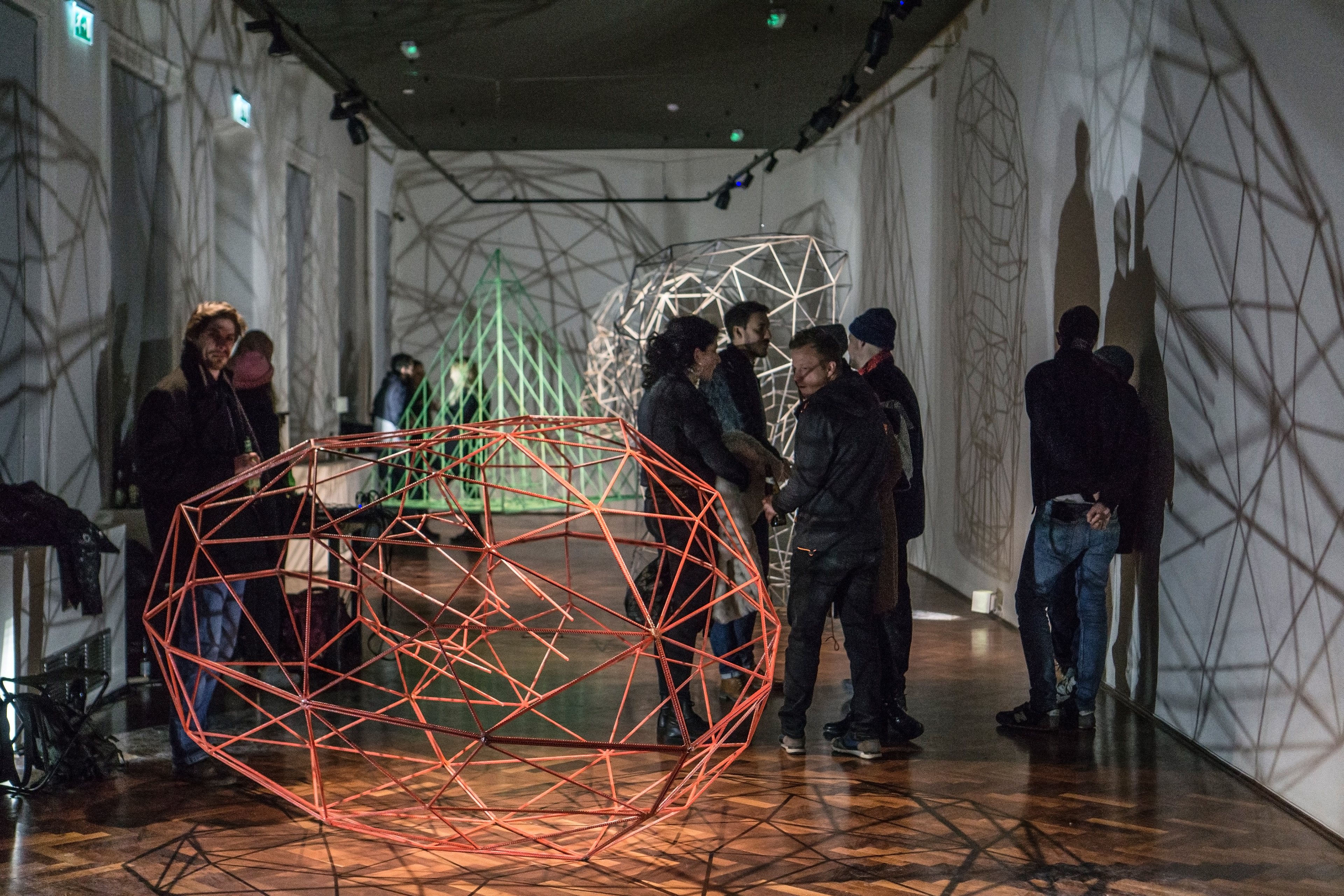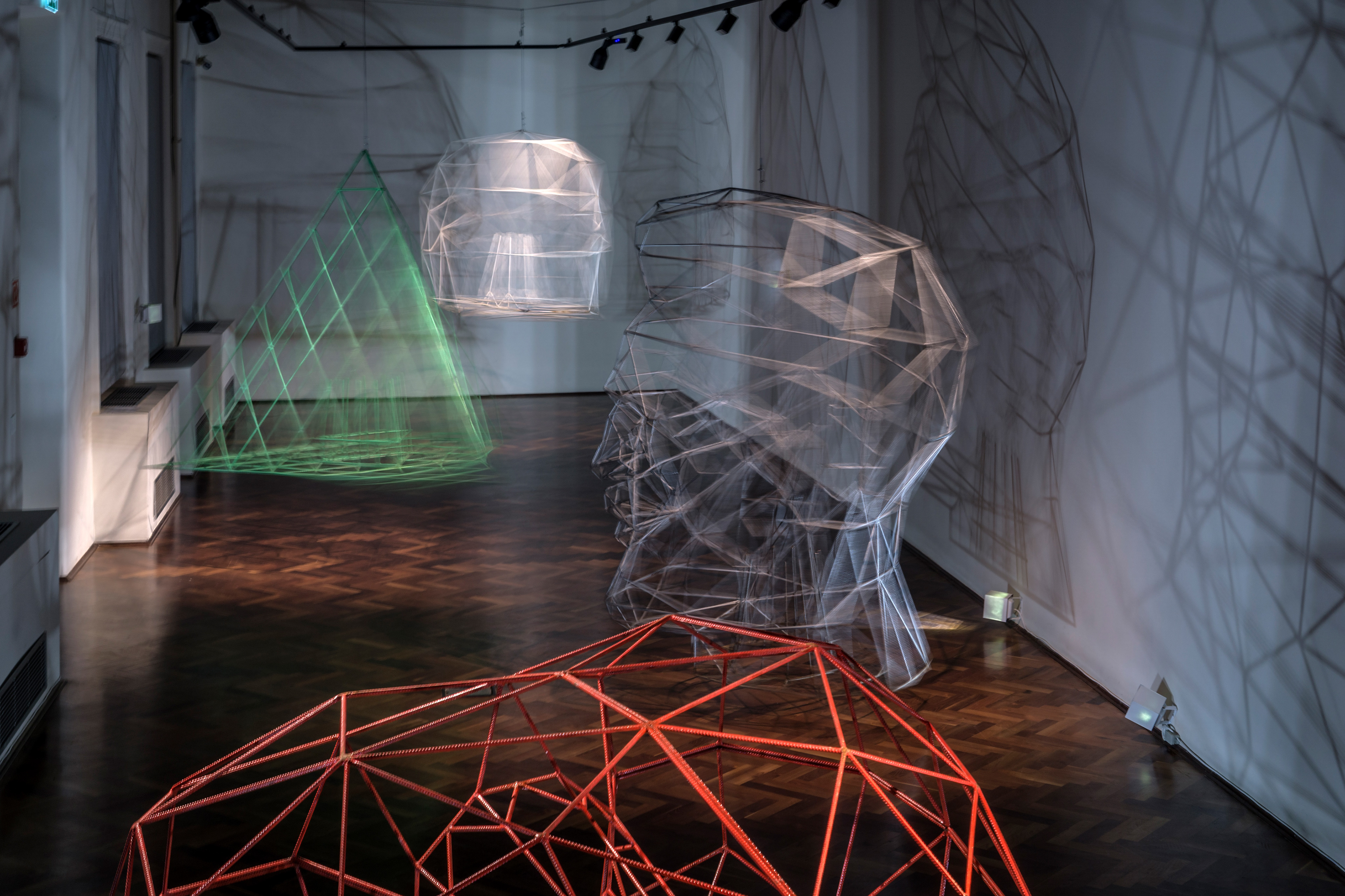
Keep_Your_Trap_Shut - solo exhibition - Esernyős Gallery, Budapest, Hungary, 2018
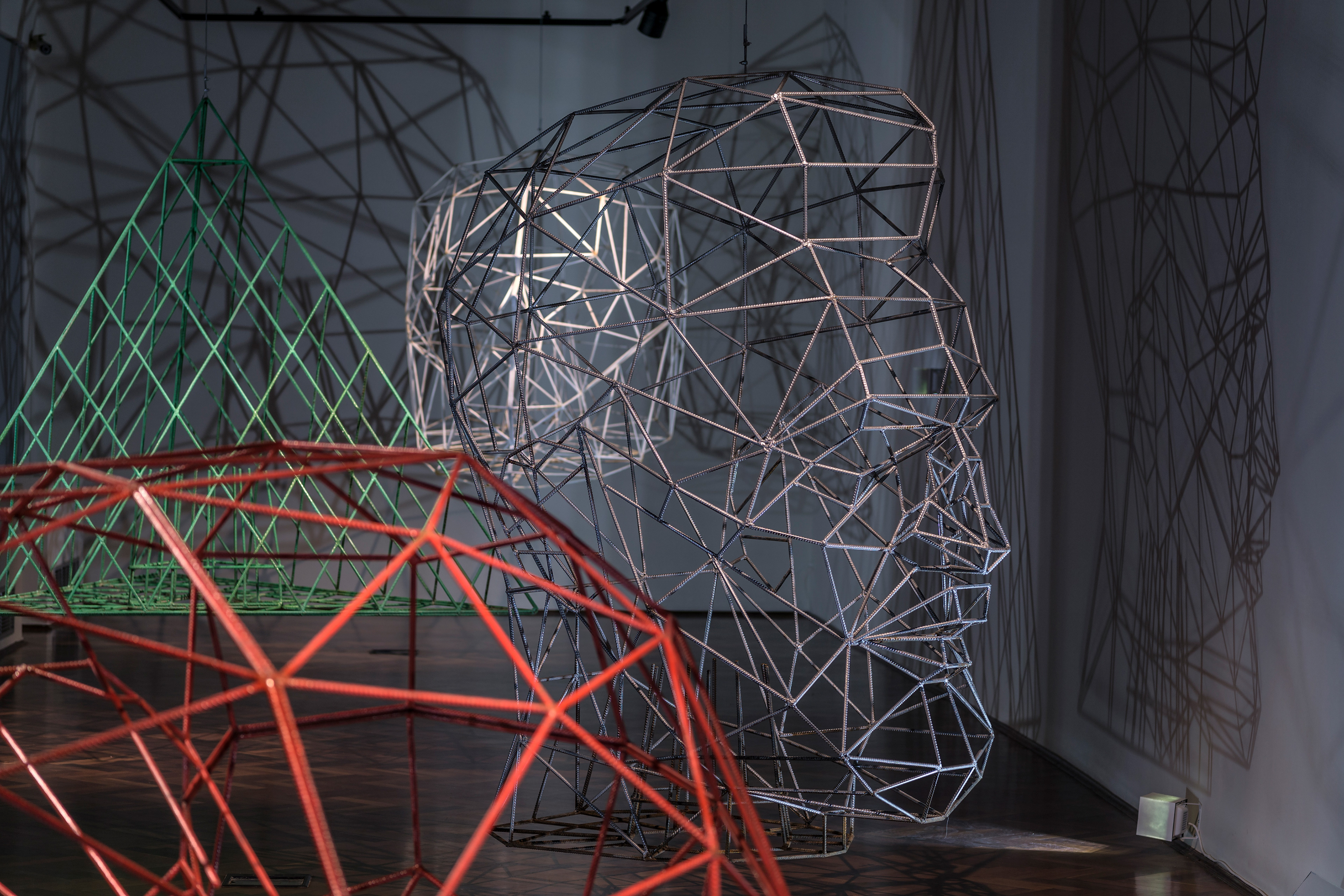
The HUMAN / Private / TRAP series currently consists of six individual “traps,” each appearing in a distinct symbolic form. The first work in the series was created in 2016 and was inspired by a fish trap (fyke net): an iconic, heart-shaped, low-poly structure made of reinforced steel, with a human-scale entrance lined with inward-pointing spikes at the top. The most recent piece was produced in the summer of 2018 upon invitation to the Echigo-Tsumari Art Triennale, taking the form of a monkey-head cage that evokes the animalistic instincts of the human being.
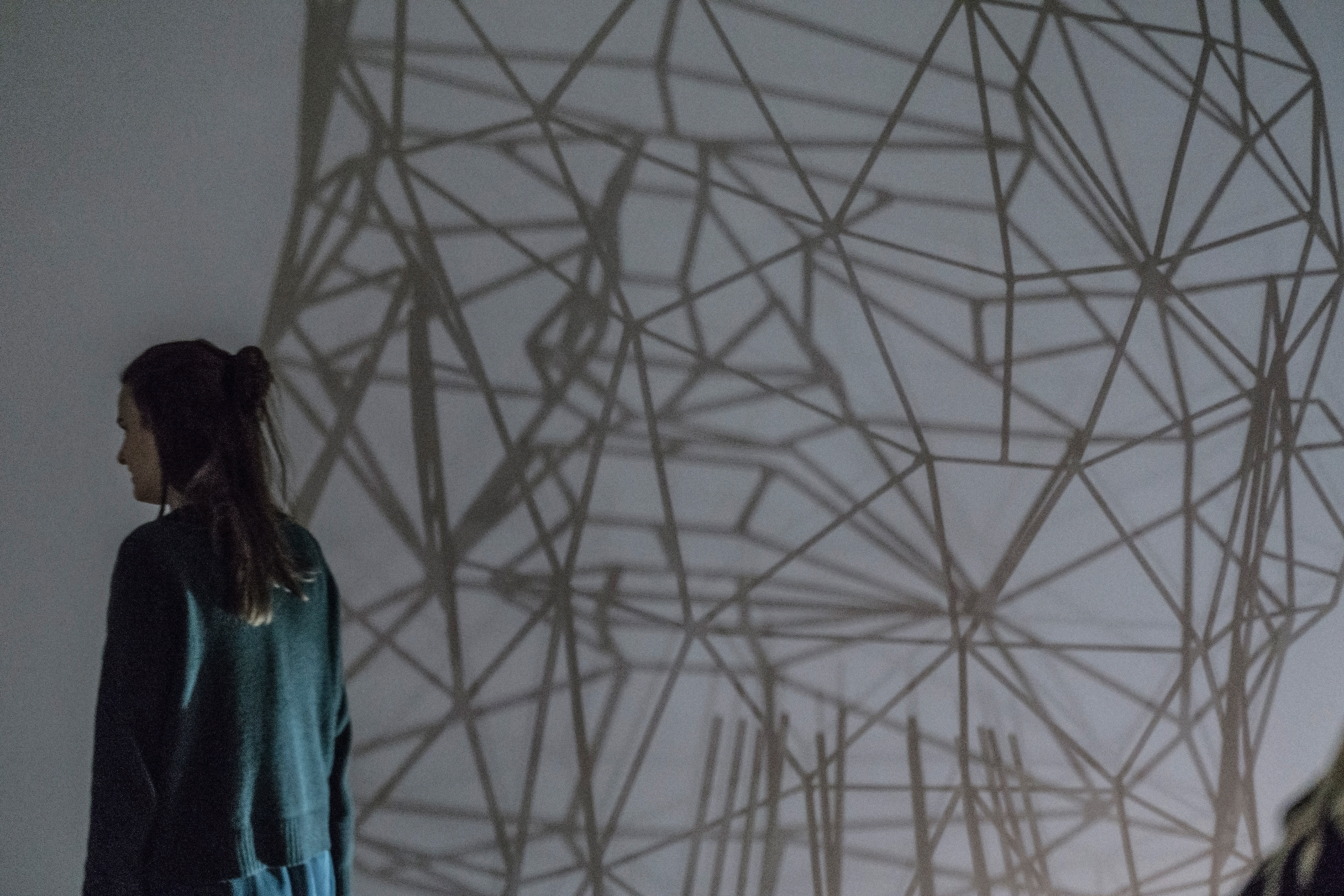
In early 2018, five elements of the series—primarily conceived for public space—were presented as a single installation at Szigeti G. Csongor’s solo exhibition Keep Your Trap at the Esernyős Gallery in Óbuda. Alongside the heart trap, the dome, skull, tetrahedron, and self-portrait traps were shown together. Within the exhibition space, cast shadows were at least as significant as the physical structures themselves: the shadow network projected onto the walls and floor created a secondary, visual trap.
The private cages—whether geometric or anthropomorphic in form—are not merely visual signs but spaces that can be entered. The viewer may personally experience the process of entering, being inside, and escaping. The mechanism is always the same: it is easy to get in through the inward-pointing spikes, yet almost impossible to get out.
Vulnerability is universal. Humans trap animals, animals trap humans, humans trap one another—and themselves. What initially appears as a tool, a decision, or a form of security gradually becomes internalized. The trap does not begin where we are locked in, but where we stop questioning why we entered in the first place. We tend to make our own prisons feel like home, because behind the bars everything is predictable.
The grid-like structure is transparent: we can see the other inside the cage, and they can see us as well. Society is not a collection of individuals, but a network of interwoven traps. Escape may occur through one’s own effort or with the help of others.
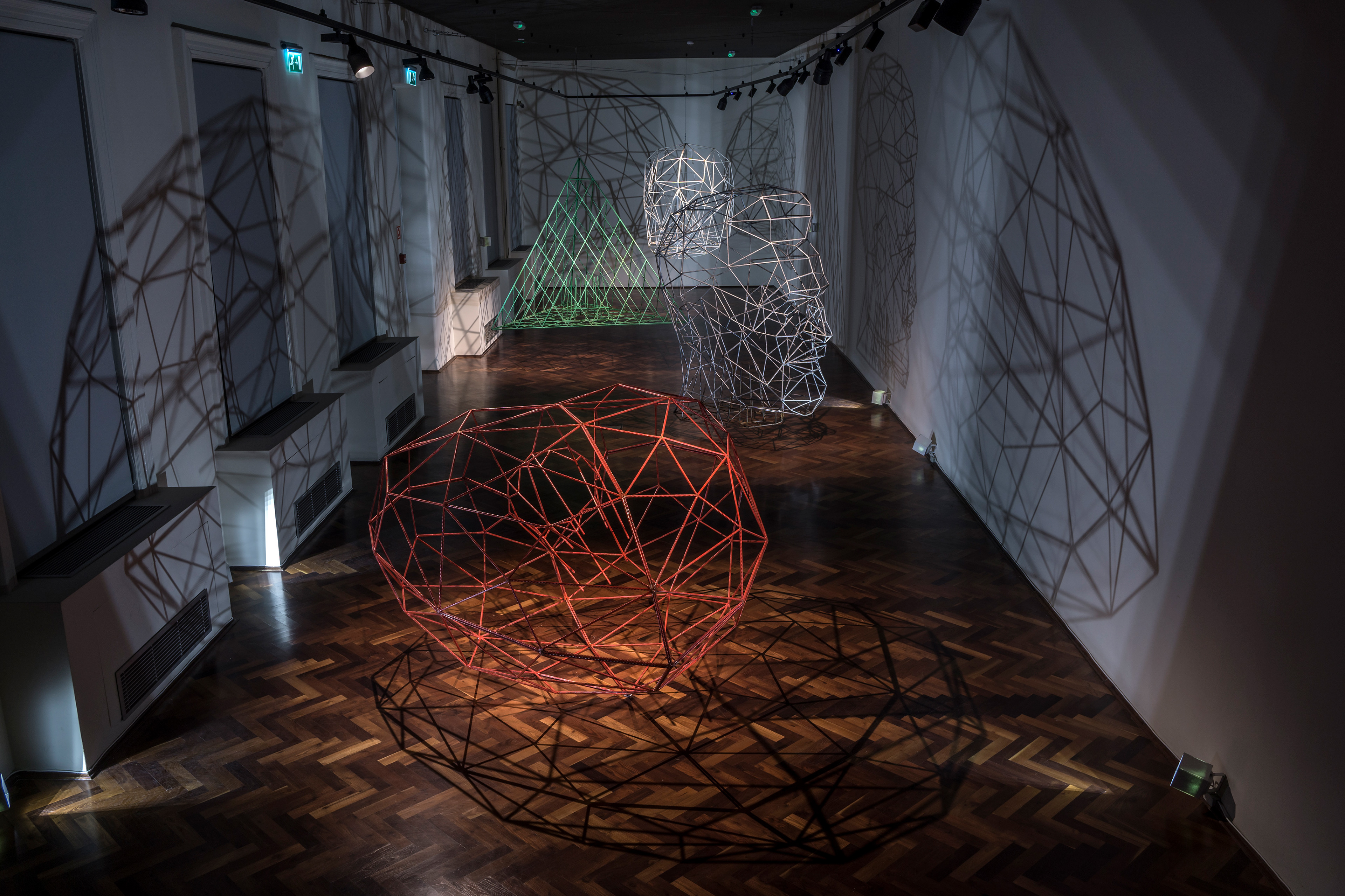
Fogd_be_a_csapdád - egyéni kiállítás - Esernyős Galéria, Budapest, Magyarország, 2018
A HUMAN / Privát / CSAPDA sorozat eddig hat különálló „csapdából” áll, amelyek eltérő szimbolikus formákban jelennek meg. A sorozat első, 2016-os darabját egy halcsapda (varsa) ihlette: ikonikus szív alakú, low poly stílusú, betonacélból készült mű, felső részén egy emberre méretezett, befelé álló tüskékkel szegélyezett bejárattal. A legutolsó darab az Echigo-Tsumari Art Triennale meghívására készült el 2018 nyarán, az ember állatias ösztöneit idéző majomfej-ketrecként.
2018 elején az óbudai Esernyős Galéria Fogd_be_a_csapdád című kiállításán a látogatók a többnyire köztérre tervezett sorozat öt elemét – a szív-, a dóm-, a koponya-, a tetraéder- és az önarckép-csapdát – láthatták egyetlen installációvá fűzve. Ebben a térben a vetett árnyékok legalább annyira fontosak, mint maguk a fizikai vázak: a falakon és a padlón kirajzolódó árnyékháló egyfajta másodlagos, vizuális csapdát hoz létre.
A privát ketrecek – legyenek geometriai alakzatok vagy antropomorf formák – nem csupán vizuális jelek, hanem bejárhatók. A néző saját maga is átélheti a bejutás, a bentlét és a szabadulás folyamatát. A mechanizmus minden esetben azonos: a befelé álló tüskéken át könnyű bejutni, kijutni azonban szinte lehetetlen.
Az ember csapdába csalja az állatot, az állat az embert, az ember pedig a másik embert – és önmagát is. Ami kezdetben eszköznek, döntésnek vagy biztonságnak tűnik, idővel belsővé válik. A csapda nem ott kezdődik, ahol bezárnak minket, hanem ott, ahol már nem kérdezünk rá arra, miért léptünk be. Hajlamosak vagyunk otthonossá tenni saját börtönünket, mert a rácsok között minden kiszámítható.
A rácsos szerkezet átlátható: látjuk a másikat a ketrecben, és ő is lát minket. A társadalom nem egyének halmaza, hanem egymásba fonódó csapdák hálózata. A szabadulás történhet saját erőből vagy mások segítségével.